
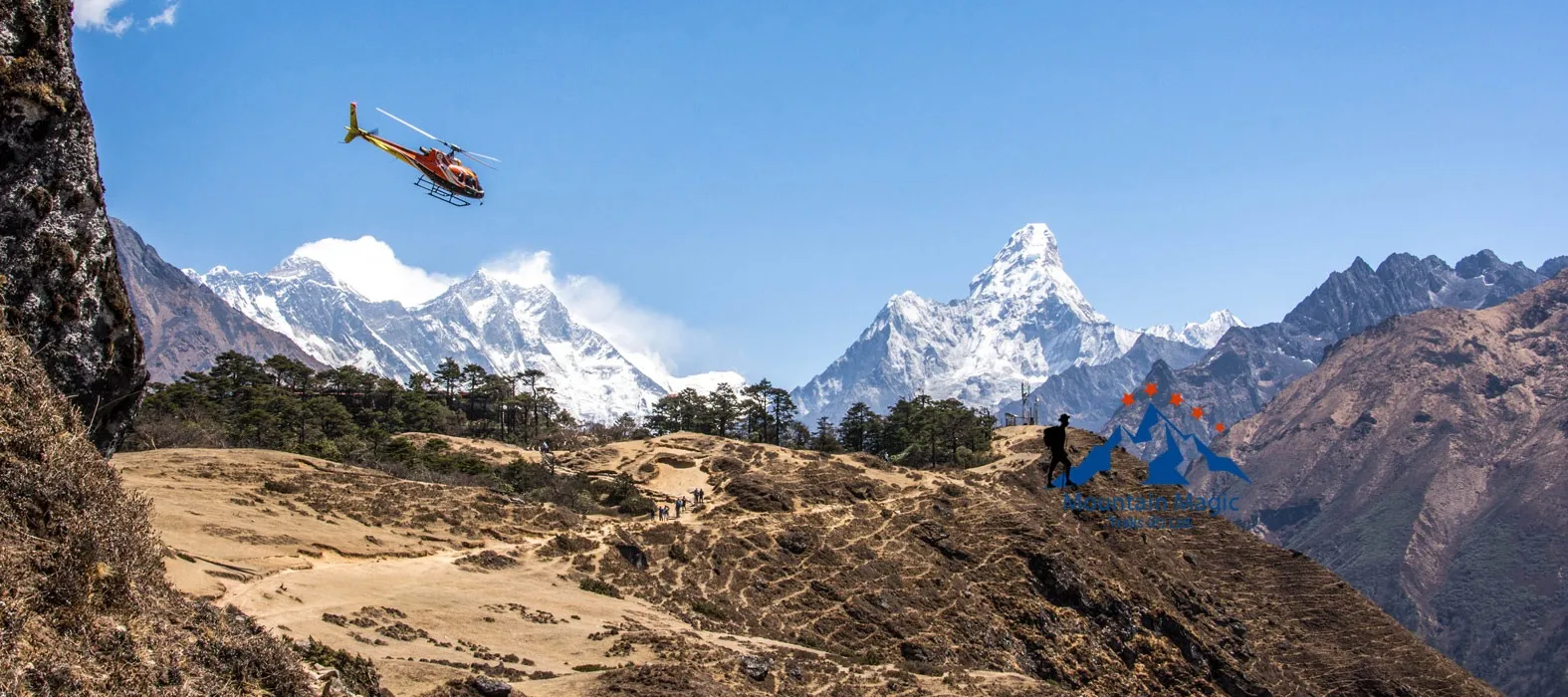
The Everest region does not look the same from start to finish.
Near Lukla, you find green hills, forests, rivers, and small mountain settlements. Farther up, the trees slowly disappear. The land becomes rocky, colder, and quieter. By the time you reach Everest Base Camp, you are surrounded by glaciers and enormous peaks.
The Everest Base Camp Trek With Helicopter Return lets you experience this change step by step. After reaching Everest Base Camp and Kala Patthar on foot, you return by helicopter instead of walking the entire trail again. The current trip plan is designed for 10 days, with acclimatization in Namche Bazaar and Dingboche.
From Green Valleys to Rocky Ground
One of the best things about this trek is how clearly the landscape changes with altitude.
You do not suddenly arrive in a frozen world. The scenery develops slowly during the journey.
The Lower Trail Feels Alive
The walk from Lukla toward Phakding introduces you to a greener side of the Everest region.
You can see trees, hillsides, rivers, and small settlements along the route. The Dudh Koshi River also becomes a familiar part of the journey as you continue toward the higher villages.
At this stage, the mountains may not yet feel as huge as you expected.
That changes soon.
Namche Is Where the Mountains Start to Feel Bigger
The trail continues toward Namche Bazaar, one of the main settlements in the Khumbu region.
At around 3,440 meters, Namche is also an important place for acclimatization. The itinerary includes an extra day here before the trek continues higher.
A Village Built Into the Hills
Namche has a very different feel from the smaller settlements lower on the route.
The village sits in a natural mountain bowl, with buildings spread across the slopes. You can find shops, cafes, lodges, and other useful services here.
It is a good place to slow down.
Instead of thinking only about the next destination, use this time to rest, explore, and prepare for the higher trail.
Forests Slowly Give Way to Open Views
After Namche, the trail continues through a mix of wooded areas and open mountain paths.
The route toward Tengboche is especially enjoyable because you get both forest scenery and wide views of the peaks.
Tengboche Changes the Mood
Tengboche is known for its monastery and impressive mountain setting.
The area combines culture and nature in a way that makes the stop feel different from the other villages.
You can see Buddhist prayer flags, traditional buildings, and the surrounding Himalayan peaks.
The itinerary also includes a visit to Tengboche Monastery.
Take your time here.
A mountain trek should not be treated like a race between checkpoints.
Dingboche Shows How High You Have Come
The next major change appears around Dingboche.
The village sits at roughly 4,410 meters, and the trees become much less common. The land looks more open, dry, and rugged.
The itinerary includes another acclimatization day at Dingboche.
The Air Feels Different
You may notice that normal activities take more effort.
Walking uphill becomes slower. You may need more breaks. Even climbing a short set of steps can leave you breathing harder.
That is part of high-altitude trekking.
Do not try to fight it by moving faster.
Give your body time to adjust.
The Khumbu Becomes a High Mountain World
Beyond Dingboche, the landscape becomes more severe.
The trail toward Lobuche passes through rocky terrain, with fewer signs of the green environment you saw near Lukla.
The mountains begin to dominate almost every view.
The Thukla Memorial Is Worth Noticing
The route passes the memorial area near Thukla, where monuments remember climbers who died in the Everest region.
It is a quiet section of the trek.
Many people stop for a moment before continuing.
The memorials are a reminder that these mountains are not simply a beautiful backdrop. High-altitude climbing and trekking come with real risks.
Gorakshep Feels Like the Final Stage
Gorakshep is one of the highest places where trekkers stay overnight on this route.
By now, the landscape is mostly rock, ice, and massive mountain walls.
The familiar forests from the lower trail are long gone.
Keep Your Expectations Realistic
At this height, your body may not perform the way it does at sea level.
You might walk slowly.
You might need frequent breaks.
That is normal.
The goal is not to prove how fast you can climb. The goal is to reach the high points safely and enjoy the experience.
Everest Base Camp Is Where the Landscape Peaks
The final walk to Everest Base Camp is one of the major highlights.
The trip page places Everest Base Camp at about 5,364 meters. The area offers views of the Khumbu Icefall and surrounding glaciers.
The Icefall Makes the Scale Clear
Photographs often make mountains look smaller than they really are.
Standing near the Khumbu Icefall changes that.
The huge blocks of ice and surrounding peaks give you a better idea of the scale of the Everest region.
This is one of those places where simply stopping and looking can be more rewarding than trying to capture everything with a camera.
Kala Patthar Takes You Even Higher
The journey continues toward Kala Patthar, the highest point listed in the itinerary.
It reaches about 5,545 meters and offers close views of Everest, Pumori, Lhotse, and Nuptse.
Sunrise Adds Another Layer to the View
Many trekkers aim for an early morning climb.
At sunrise, the first light slowly reaches the surrounding peaks. The colors change as the sun rises, creating a scene that can look completely different from the previous afternoon.
The cold can be intense, so warm clothing is important.
Then the Return Takes You Into the Sky
After spending days walking upward, the final journey feels completely different.
The Everest Base Camp Trek With Helicopter Return replaces the long return trek with a helicopter flight toward Kathmandu. The listed plan has pickup around Gorakshep or a nearby higher point, depending on weather and wind conditions.
See the Trail From a New Angle
Think about how much effort went into reaching the high Himalayas.
You crossed bridges.
You climbed hills.
You walked through villages.
You passed forests and glaciers.
Now you can see much of that landscape from above.
Valleys that once seemed huge become part of one wide picture. The trail becomes a thin line across the mountain slopes.
That change in perspective is one of the strongest features of the trip.
The Helicopter Ride Is Still Weather Dependent
A helicopter cannot simply fly because the itinerary says it should.
Mountain weather can change quickly.
The trip information notes that wind and weather can influence the return flight and possible stops. The helicopter may also make short stops around areas such as Hotel Everest View or Namche before continuing toward Kathmandu.
Leave Space in Your Schedule
Do not plan your entire trip around an exact helicopter landing time.
Allow some extra room for changes.
If the weather delays the flight, flexibility will make the situation much easier to handle.
Why This Route Works for Busy Travelers
The Everest Base Camp Trek With Helicopter Return is useful for people who want the classic trekking experience but do not want to spend several extra days walking back.
The current itinerary includes roughly 6 to 7 hours of daily activity and is rated moderate to strenuous.
It may suit:
-
Travelers with limited vacation time
-
People who want to experience the full approach to Base Camp
-
Trekkers who do not want to repeat the return trail
-
Travelers interested in aerial mountain views
-
Small groups and couples
But there is no point pretending this is an easy trek.
The helicopter saves return time.
It does not remove the high-altitude challenge.
The Best Season Depends on More Than Temperature
The trip page lists February through May and September through December as its preferred travel periods, with spring and autumn highlighted for favorable trekking conditions.
Spring Has Color at Lower Elevations
March through May can bring warmer daytime conditions and blooming rhododendrons along parts of the lower trail.
The higher you climb, the more the landscape changes from forest and flowers to rock and ice.
Fall Often Brings Clearer Skies
September through November is another popular period.
After the monsoon, clearer skies can provide excellent views of the mountains.
This can also be useful when a helicopter flight is part of the plan.
Still, no season guarantees perfect weather.
What Should You Remember Most?
The best part of the Everest Base Camp Trek With Helicopter Return may be the contrast.
You start among green hills.
Then you enter forests.
Next come high valleys and rocky slopes.
Finally, you stand among glaciers and some of the tallest mountains on Earth.
Then the helicopter takes you back through that changing landscape in a matter of hours.
It is almost like seeing the entire trek in reverse.
Conclusion
The Everest region is much more than one famous mountain.
It is a landscape that changes with every day of walking. The Everest Base Camp Trek With Helicopter Return allows you to experience those changes slowly on foot before finishing the adventure with a flight over the same dramatic terrain.
You get the forests.
You get the villages.
You get the high valleys.
You get Everest Base Camp.
You get Kala Patthar.
And finally, you get the view from above.
That combination makes the journey especially interesting for travelers who want a full Himalayan experience without spending several additional days retracing the trail.
FAQs
How long is the trip?
The current itinerary is planned for 10 days from arrival to departure in Kathmandu.
What is the highest point?
Kala Patthar is the highest point listed on the itinerary at about 5,545 meters.
Where does the helicopter return start?
The listed plan uses pickup around Gorakshep or a nearby higher point, depending on weather and wind conditions.
Are acclimatization days included?
Yes. The itinerary includes acclimatization at both Namche Bazaar and Dingboche.
Is the trek suitable for someone with limited vacation time?
Yes. The 10-day format and helicopter return can reduce the number of days needed compared with walking back along the full route.